

Yes I Can: eBook, Paperback, Audiobook Published!
There’s something to be said for projects, and self-belief, and strategic thinking, and also for the sense of accomplishment when it’s done. This post is a bit of the behind the scenes from the audio book, as I read, recorded, and produced the book. -and no, I had never done this before, but the book is published as an ebook, paperback, and audiobook (on several platforms Apple Books, Google Play Kobo and soon to be on Audible).
Before beginning I read and read and read the copious advice out there. Many people say – don’t do it yourself. By this they mean both hire someone to read and don’t do the audiobook production as it isn’t just a ‘voice memo’. I love to talk and I know I can talk- as in people like to hear my voice. (ok, I’m sure there will be someone out there who disagrees, but in general over the years I have been told there is something about my voice – maybe it’s the music in me. I don’t know. I just know I wanted to read it – I know what I meant when I wrote it, and I would know how it is meant to sound, and in the spirit of the book, I was sure of the ‘yes I can’.
At this point I know I can, because I did ! 🙂
So the process…
I wake up early, and this is a good thing, because a recording space needs to be quiet. This book was recorded at 5am over the space of two weeks. I would do a chapter a day. I used my Zoom HN4 recorder, which has done me very well over the past few years. That first session was an ear opener! Listening back I became aware of all the little things – breathing! I *breathed*. Have a go saying a sentence. Actually let’s go one step further, read the first paragraph of this post, and FEEL what you do when you breathe between sentences. LISTEN to what that space for breath sounds like and then pay attention to what you do with your tongue and lips. Really.
I noticed when I breathe in, without consideration for what I was doing, I tended to let my tongue be anywhere in my mouth, and in fact it obstructed the airflow and there was often an audible ‘cooling a mouthful of hot soup’ sort of inhale ! Can’t have that!!!! … so I had to re-do that whole chapter. 🙂
Learning. It involves thinking, doing, reflecting, adjusting, redoing, thinking…
Then there was the sensativity of the mic. It picked up all the sounds – which is why 5am was good. No heating on, no appliance noises, no outside noises, no inside noises (of course this is lockdown and I have a household full of other people who are also stuck in the same ‘space’ so my ‘workplace’ at the kitchen table was rather public!)… but the noises that I didn’t anticipate were those of my finger gently touching (not even clicking) the trackpad to scroll the text as I read. I had to learn to move more delicately than a mouse. (living opposite a farm field, we once had a mouse in the house and I do know JUST how delicately they move. I’ll tell that story another day- but I did win, and humanely, that mouse went to live happily ever after in a field FAR FAR AWAY!)
Once I sorted any unwanted breathing noise or any swallowing or even the odd lip/teeth/tongue noise, and the added tiny ‘toc’ of touching the trackpad, well then I began to think of the levels, clarity, and expression. Clarity and expression were mostly fine. My High School Speech Team set me up for that with excellent coaching on how to communicate effectively, and for that I am grateful.
Sound levels
I really did not understand these. They required negative dB levels? How could you even have negative sound levels? Initially I simply played it by ear. I set the levels where I wanted them. (haha naive girl!)
There are very strict guidelines for the average dB level for each chapter or section, and then there are guidelines for limits of any ‘peaks’. These places crop up, not always in the most emphatic or shouty place, but they also happen with plosives, like a ‘p’ sound, or even the suddenly wide open vowel of ‘and’. That one starts with a glottal stop (closed back of throat) and so even though aaaaaa is quite gentle, the word ‘and’ can make quite a BLAMO sort of unwanted peak in the sound wave.
I went through and manually edited them on Logic Pro, tapering the peaks. I’m sure a professional would have a different approach. (apologies to the professionals out there!) I did it by hand. Some blog post (correctly) said it would take at least 30 hours of post production work. At least. Here’s what one of the chapter files looks like- and you can see some sections went alright and others… well they had a lot of little niggles to sort.
If we zoom in you see my edits…

There must have been some breathing noise at the end of that first section, and then the overly loud consonants…
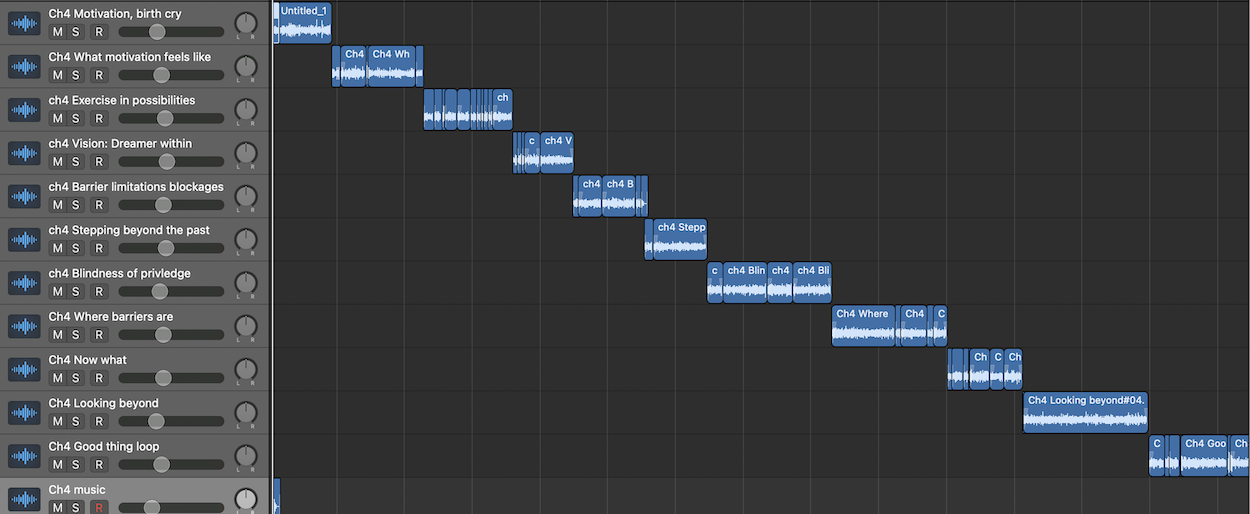
So many details cropped up, but I’ll spare you the nitty-gritty details… Suffice to say it took hours, but I am so glad to have done it. Some details I didn’t expect to be an issue, for example, apparently you can’t have text on the bottom right corner of the cover as some companies put banners and badges there. The image above contains the original cover, and I have since submitted an updated version. Also some companies will not let you start files with music, if you do this they might reject the whole book – and I had done this – each chapter started with a little cello bit. I didn’t want to risk delays with acceptance, so I redid all the chapters so they had the chapter title first and then the music.
After another 5 hours of editing, I submitted the updates. This all happened before I got the final email to say it was all ‘approved’ and so I’ve been checking that email… and this morning someone wrote to say THEY BOUGHT THE AUDIOBOOK AND ARE ENJOYING LISTENING!!!
That’s how I found out the audiobook was released!
But… those updates are underway to make it consistent across all the retail places – with the text on the top of the cover and the music after the chapter headings. I guess if you get an early copy you will have the music first !
I have learned SO very much.
If you look it up on AppleBooks you can hear the bit they chose as the ‘retail sample’, the foreword, written and read by Daniel Cervone.
(I promise I do narrate the rest of the book!)
If you do read or listen, let me know what you think!


I’m never amazed at what you can hear in the voice until you go slowly through a recording reading the wave forms. Yes, I can (see what I did) visually recognize the hump of all my “umms” but in editing podcasts, there are distinctive bits I find in the pacing of words, and where the breaths come.
I’ve long relied on The Levelator app for getting even levels. It was developed by the now defunct Conversations Network podcast, as I understand, it incorporates all the steps an audio engineer would do to even out the levels, into one drag and drop (requires a .wav or .aif) https://en.wikipedia.org/wiki/Levelator There is a modern version. I still use it for podcasts, I do my recording so I get each speaker as a separate audio file, process it with the Levelator before editing as usually each speaker has varying audio levels.
Ok, I am overdue to buy your book, sorry Laura (fill in excuses here). I’m so proud of the work you have done on this project and writing of making of it here.